
 Product catalog
 Partner
 Contact



Removing air from lubricants: Professional degassing of greases and lubricants
We remove air bubbles from lubricants and greases – ensuring completely stable dosing processes, maximum process reliability and consistent production quality.
The highest standards for modern dosing processes
In many production processes, particularly in highly automated production lines, lubricants and greases must be dispensed with high precision. Even the slightest deviation in the application quantity can compromise the functionality of the final component. Air pockets in the material cause significant and often costly problems. This inevitably leads to inaccurate dispensing results.
This is precisely where our professional lubricant degassing system for degassing demanding media comes into play: we reliably restore the original material quality, ensure the required production cycle times and protect you from costly material wastage.
The benefits at a glance
- Residue-free removal of air bubbles in the lubricant
- Significantly more stable and reproducible dosing processes
- Maximum process reliability throughout production
- Prevention of costly scrap and plant downtime

Air in lubricants is a production risk
Typical consequences of using material contaminated with air include inaccurate dosing quantities, unstable dosing processes and unpredictable fluctuations in the quality of the final components. In the worst-case scenario, contamination caused by air entrapment can lead to the complete shutdown of production lines.
This is particularly critical in automated dosing systems, high-precision lubrication processes and the manufacture of safety-critical components. Here, there is zero tolerance for errors. To ensure this, professional degassing of the material beforehand is often the only reliable way to safeguard the process.
This is how air bubbles form in lubricants
Even the highest-quality lubricants can arrive at the user’s premises already contaminated with air. Air can enter the material in a variety of ways:
- Through filling processes directly at the manufacturer
- Through vibrations during transport and storage
- Through improper manual decanting on the user’s premises
- Through the use of unsuitable container sizes for the respective system
Vacuum degassing of lubricants
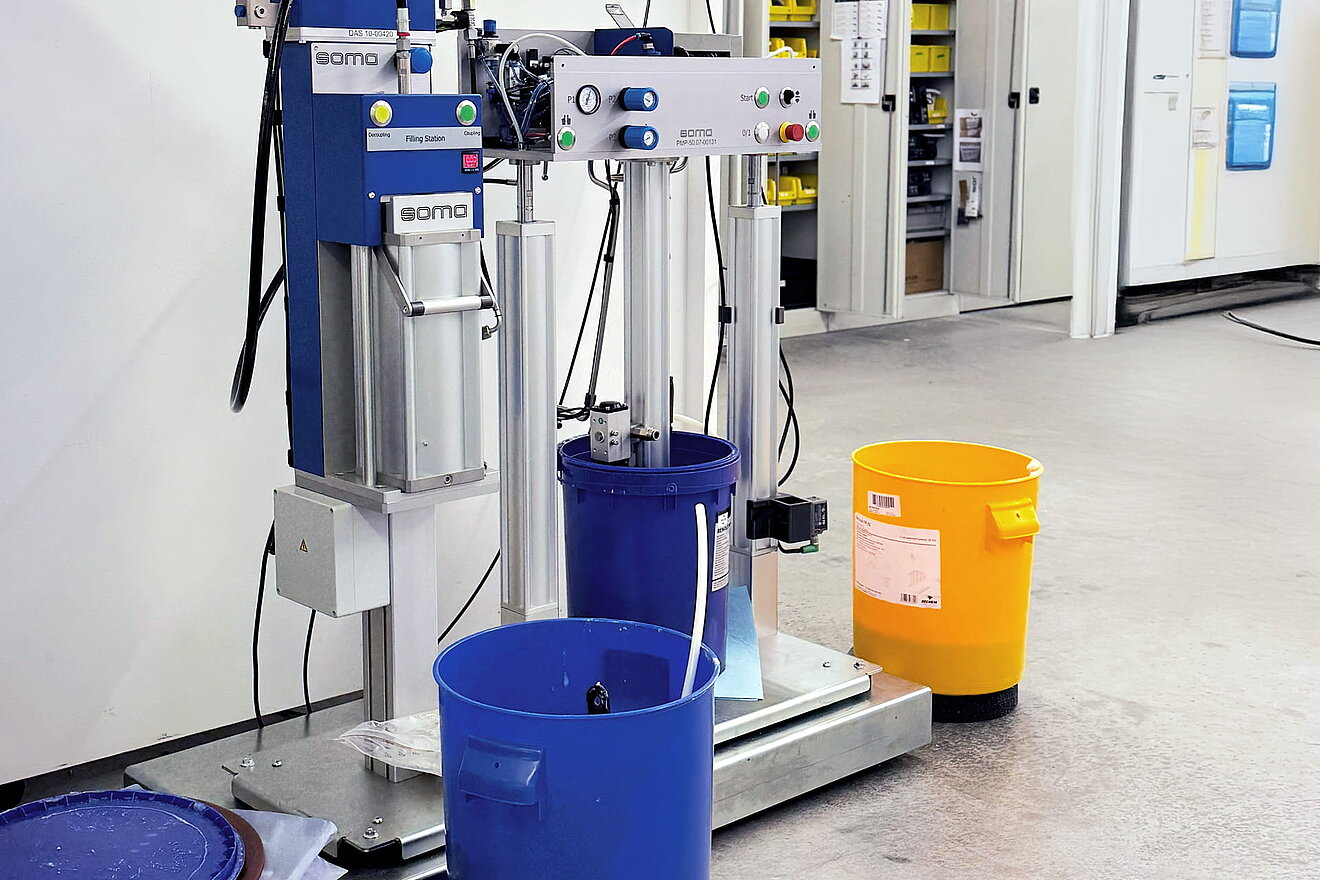
Using our advanced degassing technology, we remove unwanted air pockets from your lubricants and greases.
Our quality commitment to degassing
The lubricant is treated using a special process in which air bubbles are completely removed from the material through precise vacuum degassing.
The lubricant is handled with extreme care during this process. The chemical structure, viscosity and all the original properties of the medium are fully preserved.
The result is a perfectly homogeneous, air-free lubricant that can be processed mechanically again immediately with absolute reliability.
When is degassing advisable?
The professional treatment and degassing of fats and lubricants is particularly recommended in the following situations:
- Dosing systems detect air: Their sensors or dosing inspection systems trigger an alarm and indicate the presence of air bubbles in the material.
- Uneven dosing: The grease is applied unevenly because compressed air bubbles lead to inaccurate dosing quantities or uncontrolled ‘over-pressing’.
- Unstable production processes: Your dosing points on the components fluctuate and are no longer reproducible.
- Recovery of high-quality lubricants: In the case of very expensive speciality lubricants that have been contaminated, recycling offers enormous economic benefits.
Who would benefit from degassing?
Our service is relevant across all sectors, but offers the greatest added value to companies with:
- Highly automated dosing processes
- High-quality and cost-intensive lubricants
- Microscopically precise assembly processes (e.g. automotive, electronics manufacturing, medical technology)
Cost-effectiveness: Reconditioning and vacuum degassing are particularly beneficial when the lubricant has a high material value, large quantities are involved, or costly production downtime needs to be avoided. Particularly in the case of expensive specialist lubricants, degassing is significantly more cost-effective and sustainable than completely replacing and disposing of the old material.
How lubricant degassing works
We make the process as transparent and straightforward as possible for you.
Delivery
Simply send us the air-contaminated lubricant in its original container.

Documentation & Goods Receipt
We record the exact type of lubricant, the container size and the quantity.

Degassing
The lubricant is processed in our specialised equipment, where air bubbles are completely removed from the material through degassing.

Quality control
We carry out a rigorous inspection of material quality and homogeneity following complete degassing.
Returns
The degassed lubricant will be returned to you safely in its original (or, if preferred, new) containers.
Degas the lubricant and refill it straight away
We offer a comprehensive solution: once degassing has been successfully completed, the lubricant can be decanted directly into containers that are suitable for your specific process requirements, if you so wish.
- Cartridges for automated systems
- Smaller production containers
- Specialised containers for your dosing systems

Advice on contract filling and contract degassing
Do you have questions about contract filling and contract degassing? We are happy to help. Talk to me.
Personal contact person
Justus Dräger
Phone: +49 2355 50828-934
E-Mail: dosing@soma.de
Common degassing methods and principles
Degassing refers to the removal of dissolved gases from a liquid. The basic principle involves reducing the partial pressure of the gaseous phase, or heating the solution or reducing its solubility, so that the dissolved gases are released. Processes such as vacuum degassing reduce the pressure, allowing dissolved gases to escape from the solution more quickly.
Vacuum degassing is a process in which the partial pressure of dissolved gases is reduced by lowering the pressure above the liquid. As a result, the liquid can no longer hold the gases and they begin to escape. This method is frequently used when thermal stress needs to be avoided or when a very low residual gas content is required.
Degassing reduces the presence of gas bubbles, which can prevent optical defects, cavitation in pumps, porosity in coatings or corrosion. Improved degassing leads to greater process stability and better product quality, as dissolved gases often influence chemical reactions or cause physical defects.

We support you in all phases of your project
SOMA is at your side as a reliable technology partner in every project phase – design, implementation, training and after-sales. You can count on our experienced team and our expertise.
Non-binding and personal advice
Sometimes you need quick and straight-forward help. We are here for you.
Phone: +49 2355 50828-0
E-Mail: info@soma.de